

Barrel-shaped mimetite crystals, particularly from the Dry Gill Mine in Cumbria, have historically been called “Campylite”.
So what is this campylite?
Campylite gets its name directly from the crystal shape. It comes from the Greek καμπύλος (kampylos) meaning bent or curved, and referring to its distinctive barrel‑shaped curved crystals that distinguish this style of mimetite. So literally “bent stone”.
The name was in use in the mid 1800s with Johann Friedrich August Breithaupt first to describe this variety as Kampylite. Greg and Lettsom reported it as occurring in large quantities at Drygill (sic) of various colours, yellowish to brown and brownish red.
It is definitely a favourite among collectors of Cumbrian minerals.
Richard Gibson also wrote about campylite back in 2024.
Below: Mimetite, Dry Gill Mine, Caldbeck Fells, Cumbria, England, UK. 50x30x28mm.
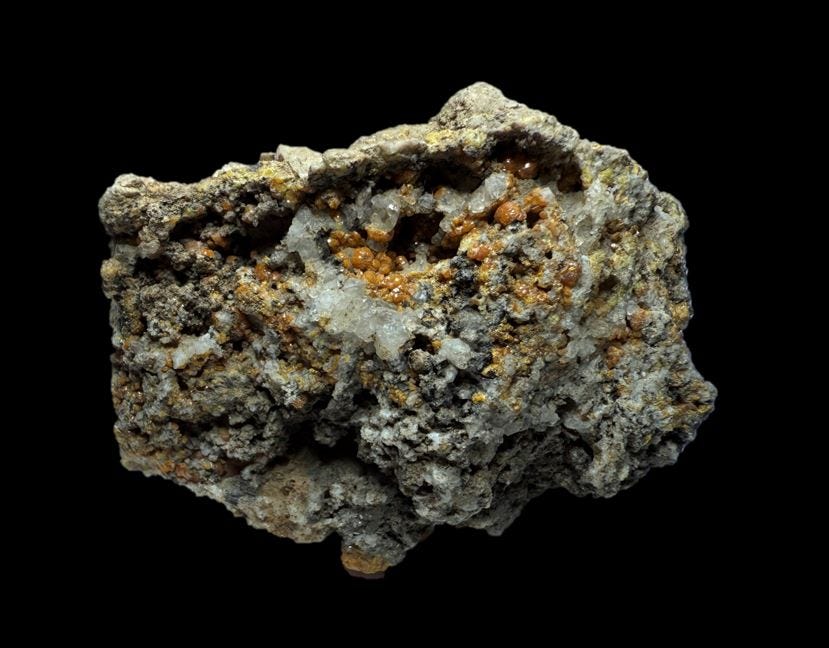
Not much left at type locality now!