
Mullite
Mineral Matters #1025

Mullite, formula Al4+2xSi2-2xO10-x (x ≈ 0.4), is a rare silicate mineral in nature, primarily because its formation requires a specific “Goldilocks Zone” of extremely high temperatures and relatively low pressures. While rare in the Earth’s crust, it is a cornerstone of industrial ceramics and refractories.
Formation Conditions
Mullite typically forms through the decomposition of aluminosilicates (like kyanite, sillimanite, or andalusite) or clay minerals (like kaolinite) under the following conditions:
High Temperature: Formation usually begins above 1050°C and becomes stable at even higher temperatures (up to 1840°C, its melting point).
Low Pressure: It is a characteristic mineral of low-pressure, high-temperature (LP-HT) metamorphic facies.
Chemical Environment: It requires an environment rich in aluminum and silicon but poor in “fluxing” elements like iron, magnesium, calcium, or alkalis (sodium/potassium), which would otherwise cause the rock to melt into a liquid before mullite could crystallise.
Natural Environments
In nature, mullite is almost exclusively found in environments where high-temperature magmas or combustion processes interact with aluminum-rich sedimentary rocks.
Pelitic Xenoliths (Sanidinite Facies): The most common natural occurrence is within xenoliths, fragments of “country rock” (often shale or mudstone) that have been accidentally caught up in basaltic or other high-temperature lavas.
As the magma heats the fragment to extreme temperatures, the clay minerals undergo pyrometamorphism.
The resulting rock, often called a buchite, contains microscopic needles of mullite embedded in a glassy matrix.
Paralavas and Combustion Metamorphism: Mullite can form during the natural (or accidental) burning of coal seams.
When a coal bed ignites underground, the intense heat bakes the surrounding shales and clays.
The resulting “clinker” or paralava can reach temperatures sufficient to crystallise mullite, often alongside minerals like tridymite or cristobalite.
Contact Aureoles: In rare instances, mullite is found in the innermost “hot zone” of a contact metamorphic aureole, where a massive igneous intrusion stays hot enough for long enough to transform the adjacent rock. The most famous locality is the Isle of Mull in Scotland, for which the mineral is named.
Industrial Context
Because natural mullite is so rare, almost all mullite encountered today is synthetic. It is produced by calcining kyanite or bauxite/kaolin blends.
This makes it the primary material for furnace linings, spark plug insulators, and high-performance laboratory crucibles.
See also Richard Gibson’s post on mullite.
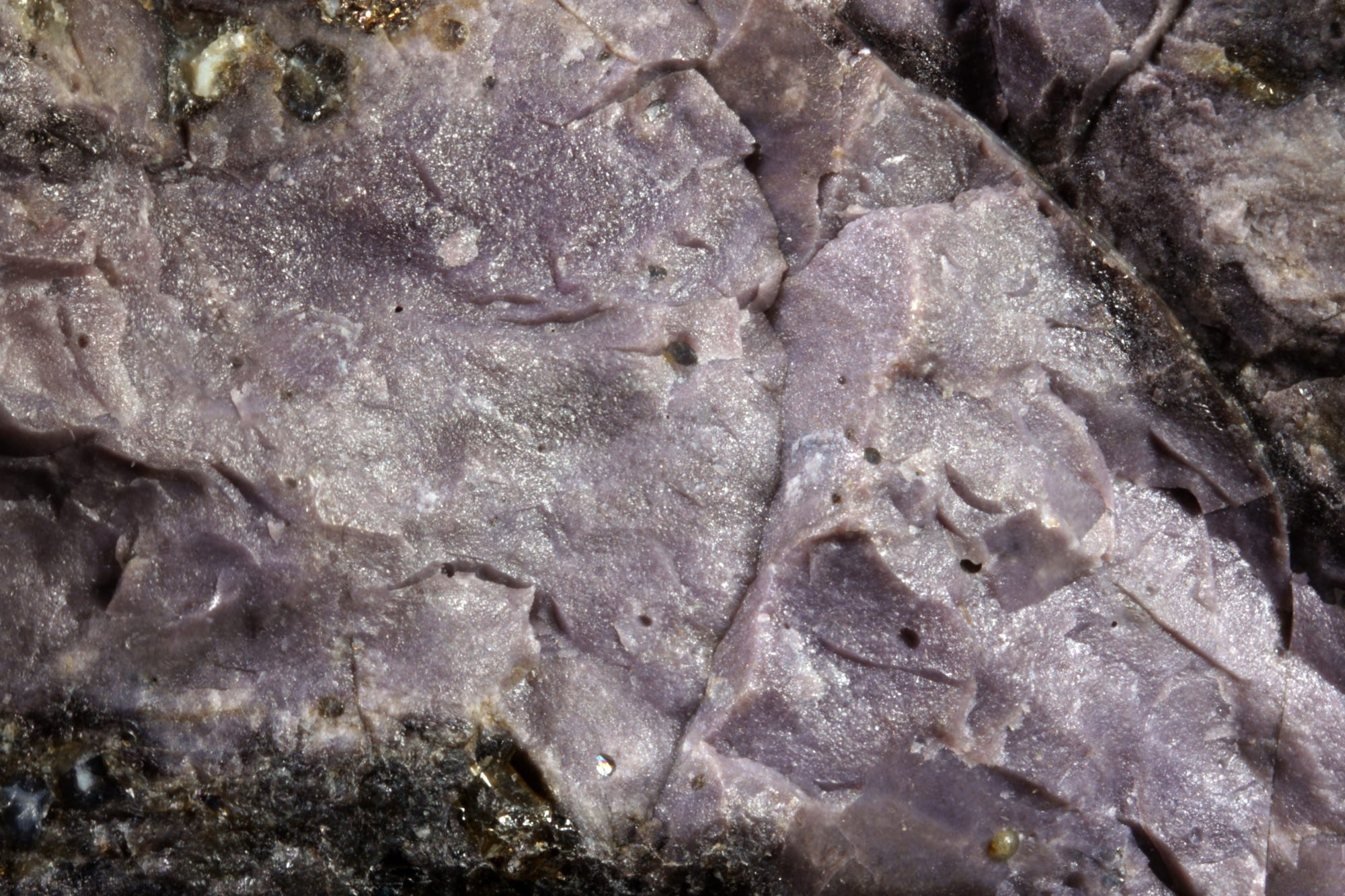
Below: Purple K-Na bearing aluminous glass with minor, sub-microscopic mullite, pyrrhotite, spinel, quartz, and corundum, Raeburn Quarry, Breadalbane, Tasmania. Width of view 5mm.
This is great, I linked to your post from mine about mullite. https://richardigibson.substack.com/p/mullite
I purchased an historical industrial specimen at Tucson this year. Butcant recall the factory that the dealer said it came from. It was a ceramicsfactory in Europe that burned tithe ground. You do t happen to have any clues?