
Phillipsite Twins
Mineral Matters #778

The mineral phillipsite is a common zeolite. However, it often harbors a secret. Even crystals that look like just, well, crystals, are twinned!
First, it's important to understand that phillipsite is a monoclinic mineral. However, its crystal lattice parameters are very close to being orthorhombic. This is called pseudo-orthorhombic symmetry. This "near-symmetry" is the primary reason it twins so readily and in such specific, repeated ways. The crystal "wants" to achieve a higher symmetry, and twinning is a way to do that on a macroscopic scale.
1. The Marburg Twin Law
This is the most famous and visually striking twin law for phillipsite.
Twin Type: Contact Twin. The crystals are joined along a single, shared plane (the composition plane).
Twin Plane: The twinning occurs on the {001} plane (the basal pinacoid).
Resulting Appearance: This law produces the classic cruciform (cross-like) twins.
Simple Twin: Two crystals join to form a simple cross.
Fourling (Quadruplet): More commonly, four individual crystals intergrow, all twinned on the {001} plane, radiating from a central point. This creates a distinctive shape that can look like a Roman cross (if the arms are at 90°) or a St. Andrew's cross (if the angles are oblique). Sometimes known as a drillbit habit.
These Marburg twins are what give phillipsite its most recognisable habit, especially in volcanic vugs where they have room to grow.
The pseudo-symmetry of phillipsite leads to even more complex phenomena:
Mimetic Twinning: This repeated, microscopic twinning makes the overall monoclinic crystal mimic a higher symmetry. This is why a phillipsite "crystal" that looks like a single orthorhombic or tetragonal prism is, in fact, a complex intergrowth of multiple, smaller monoclinic crystals. This is the source of its prismatic habits and the formation of radial, spherulitic aggregates.
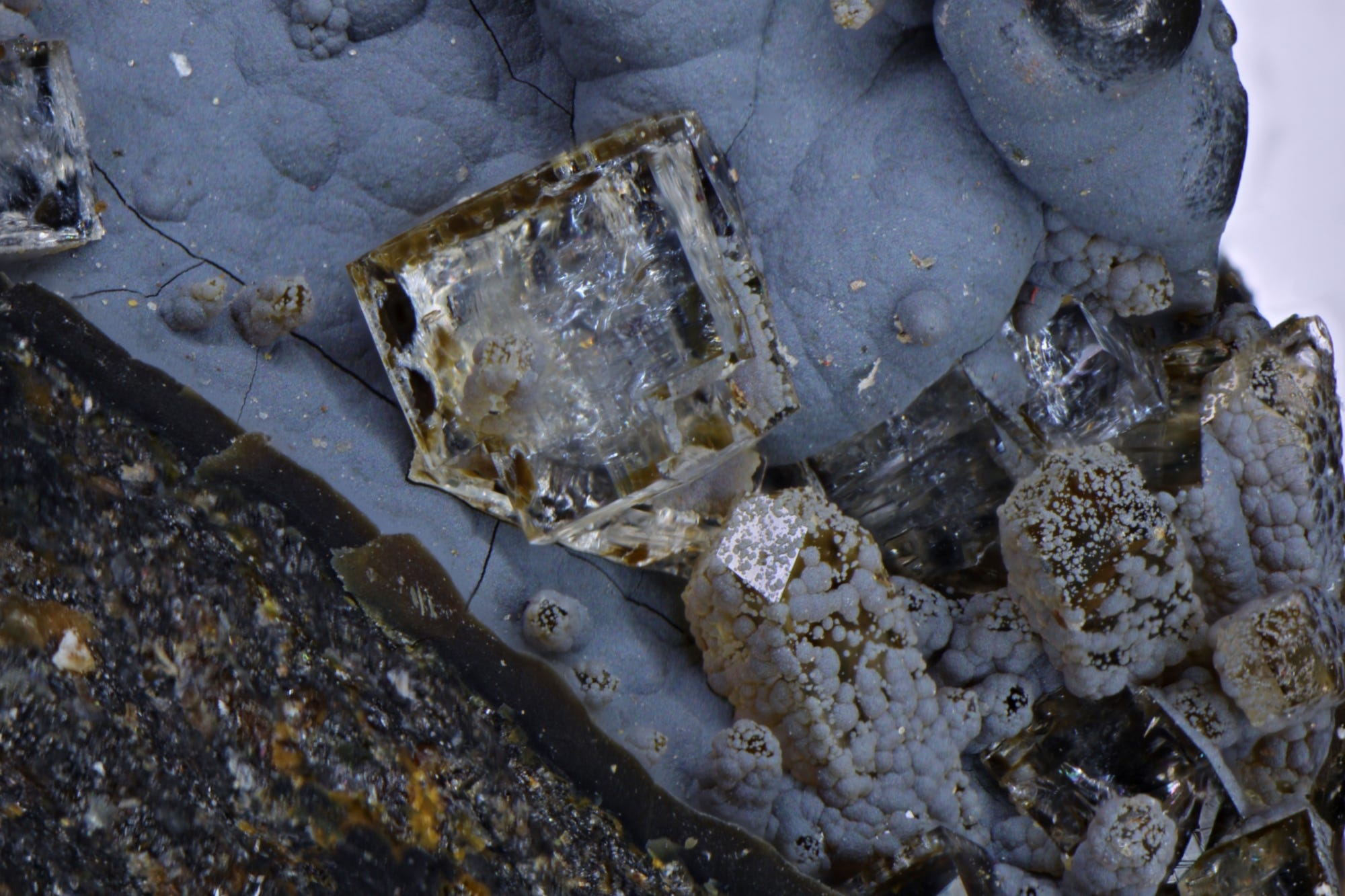
Below: Marburg Twin Law phillipsite with pseudocubic chabazite, Cairns, Queensland. Width of view 3.75mm.
Very cool! Complex twinning is so interesting. Our pugs follow the Japanese law of twinning, they only touch each other at those angles! I guess they’re exhibiting puggie twinning? 😆👍❤️💙🦋